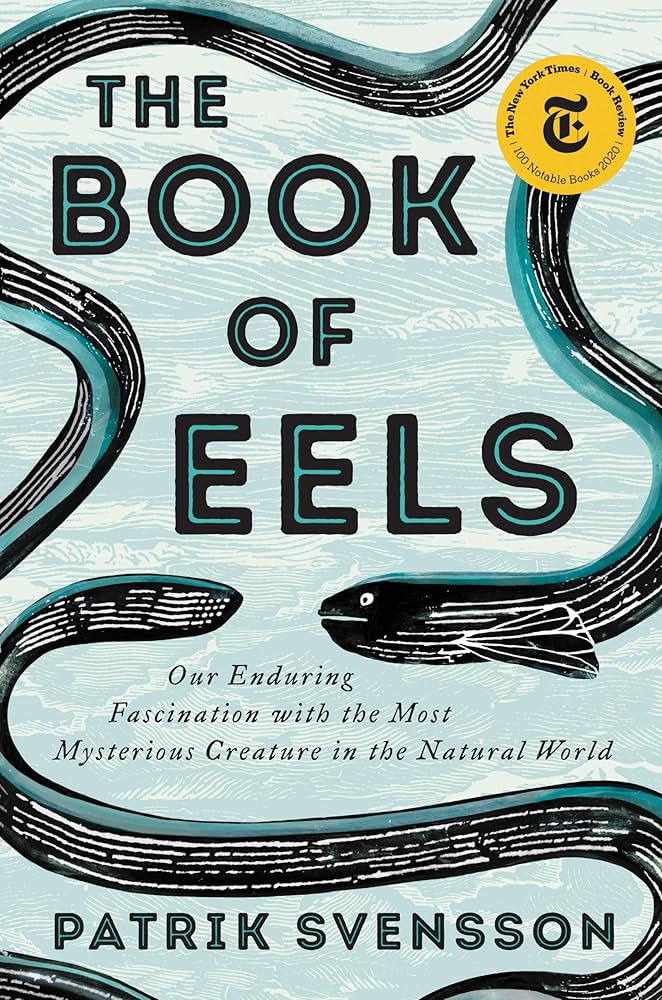
The Book of Eels
I'm a big fan of nature documentaries and anything David Attenborough. His newest film, Oceans, was fantastic. You know then that I went into this expecting "Planet Earth: The Audiobook", but the reality of this book is something different.
In a way, the Book of Eels is the inverse of a nature documentary. Where Planet Earth is a human story about animals, this book is, in actuality, an animal story about humans. The tidbits and details about the eel itself, though crucial, are thin layers of ricotta in a larger lasagna.
The real story here, the layers of noodles, sauce, and melty cheese, is about the human struggle to discover these elusive secrets. The most profound takeaway from this book is just how profound the eel has been to humanity. It's baffled scientists, shaped communities, inspired rituals and festivities for generations. To this day, that no eel has ever been bred in captivity, should amaze you. Not once, ever, with all the knowledge of humankind at our fingertips. Wow.
I appreciate the book of eels for the sum of what I learned. Enough in fact to order a physical copy. But it is a book I like, not love, and one that has a "despite its flaws" tacked onto the end.
In a book so short, each page is valuable real estate, and I found myself wondering why they built so many car washes on one road. I understand the author's intent with sharing stories of his childhood. It's a sort of glue that holds some of the book together, and its omission would be a detriment. But not all of it feels relevant, at least for the amount of space it takes up. The stories of the eel that escaped in the garage, the aunt using the dowsing rod, and some parts of other stories were a lot said but amounted to little point (sort of like this review!).
I felt this same sentiment when other parts of the book would split off into a tangent. I still struggle to see the relevance of Freud's relationship with women and the amount of focus it got.
I'm not sure I could pick a single most interesting thing about the book. It's the sum of it all that made it a worthwhile read for me. I will say though, the part about Rachel Carson with Anguilla and how she personified eels and other creatures was really fascinating to me. I'm curious to go take a peak at the full verson of those.
All in all, I enjoyed my time with it. It's no book of the year, but it was a good read.
Back of the Book Overview
Remarkably little is known about the European eel, Anguilla anguilla. So little, in fact, that scientists and philosophers have, for centuries, been obsessed with what has become known as the “eel question”: Where do eels come from? What are they? Are they fish or some other kind of creature altogether? Even today, in an age of advanced science, no one has ever seen eels mating or giving birth, and we still don’t understand what drives them, after living for decades in freshwater, to swim great distances back to the ocean at the end of their lives. They remain a mystery.
Drawing on a breadth of research about eels in literature, history, and modern marine biology, as well as his own experience fishing for eels with his father, Patrik Svensson crafts a mesmerizing portrait of an unusual, utterly misunderstood, and completely captivating animal. In The Book of Eels, we meet renowned historical thinkers, from Aristotle to Sigmund Freud to Rachel Carson, for whom the eel was a singular obsession. And we meet the scientists who spearheaded the search for the eel’s point of origin, including Danish marine biologist Johannes Schmidt, who led research efforts in the early twentieth century, catching thousands upon thousands of eels, in the hopes of proving their birthing grounds in the Sargasso Sea.
Blending memoir and nature writing at its best, Svensson’s journey to understand the eel becomes an exploration of the human condition that delves into overarching issues about our roots and destiny, both as humans and as animals, and, ultimately, how to handle the biggest question of all: death. The result is a gripping and slippery narrative that will surprise and enchant.